Remedy Connected Universe. That’s what Remedy announced when they first unveiled AWE and confirmed that speculations were indeed correct. The Alan Wake Easter eggs in Control are so much more than Easter eggs and AWE is the first real overt bridge between Control and Alan Wake. So then, AWE must be looked at from two different angles. For some, AWE will simply be an expansion to last year’s beloved Control. For others, it’s a pseudo-sequel—or supplement, rather—to the oft-missed Alan Wake games, Xbox exclusives that haven’t seen a new release in about a decade. How AWE stacks up is largely going to come down to what your past experience is with Alan Wake and whether the crossover references are enough to get you excited.
Spoiler Warning: This review does contain some spoilers for Control: AWE in order to talk about its connective tissue to Alan Wake and what players who didn’t play Alan Wake will get out of it.
As is par for the course with Control, AWE begins with Jesse Faden hearing a mysterious voice (Alan Wake) calling to her, telling her to get into the elevator and explore the closed off Investigations sector. Unlike The Foundation DLC, which explored the caves beneath the Oldest House, as well as some strange planes of existence, the Investigations sector is just another wing of the Federal Bureau of Control. It’s more of the brutal concrete walls and sterile hallways, offices, and containment areas. It’s an aesthetic I love, and one of Control’s defining features, to be certain, but if you’re expecting to be surprised by the environments here, think again.

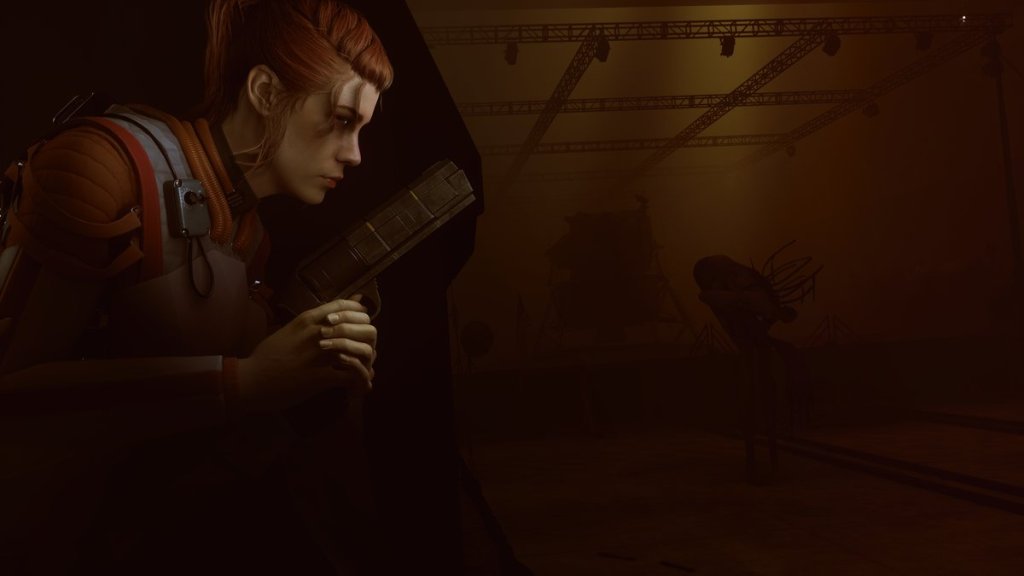
The biggest change is to the overall mood of Control, which takes on a real Alan Wake pseudo-horror vibe. The Investigations Sector is dark, and bad things (or one bad thing, rather) lurks in the darkness. Many of the puzzles here involve turning on lights and avoiding the darkness, lest a horrifying stretched out creature of a man drains the very life-force from you. AWE plays with these ideas briefly, but it’s a short DLC, easily ending in under two hours, so some of its mechanics don’t really feel that they get as fully fleshed out as they could be. But the real draw here, and obviously what Remedy is leaning on with this expansion, is the story connection to Alan Wake. However, AWE is more setup and less “Remedy’s Avengers.” It’s the interactive equivalent of Remedy’s blog post confirming a Remedy Connected Universe.
If you’re one of those who missed Alan Wake the first time around? There are plenty of explainers in AWE to help get you up to speed relatively well, but many of the references certainly aren’t going to land in the same way as for those who actually experienced it firsthand. You don’t need to have played Alan Wake to understand everything, but AWE feels like it is leaning on the lore connections between the two games for its “wow” moments.
Control AWE Review – Questions and Mysteries
Some of the most intriguing story elements come from documents and collectibles scattered around. Again, this was one of the strengths of the main game as well, making the player connect with Jesse as an outsider to everything that’s going on. There’s a fair amount of detective work needed to piece everything together, and even then, it often leads to more questions and mysteries. In one series of documents, it turns out Alan Wake wrote a spec script for Night Springs, the in-universe take on The Twilight Zone. With Wake’s writing able to come true, these script pages seem to imply that he’s the one who caused Director Trench to open the portal, unleash the Hiss, and the cause the events that led to Control’s main campaign.
Sadly, none of this is really touched on all that much in AWE’s direct story. Instead we get what amounts to a side mission to clear a horrifying and murderous creature from the Investigations Sector, a creature who turns out to be Alan Wake’s Dr. Emil Hartman. And that’s pretty much the gist of it. This isn’t about rescuing Wake. It’s just more Control, more clearing of evil entities from the Oldest House. And more fighting Hiss, with a single new weapon and one new enemy type who’s not all that distinguishable from the Hiss you’ve already been fighting. The sector-wide boss encounters with Hartman are a pretty good driving force though, and really double down on the horror mood AWE is going for.

The side missions in AWE are also some of the weakest in Control so far. While I was extremely excited by the prospect of learning about more Altered World Events and interacting with Altered Items, the few you’ll find here are less than memorable events that result in rather boring missions. In one, you’ll forward a spam chain letter that came from an Altered mailbox. Another has you cleansing a train car of the memory of its train crash. And perhaps the most potentially interesting one, but still ranked low on my list of best Control missions, a scavenger hunt on behalf of an alien entity locked in a containment cell who has jumbled the meaning of the entire English language. AWE is simply lacking its own Ashtray Maze or Swift Platform moment (though there is a cheeky reference to Swift Platform that made me chuckle).
Remedy did manage to work some alternate game modes and replayability into two arcade cabinets titled SHUM and SHUM II, Altered Items that “transport the user into a ‘video game-like state.'” It’s a clever in-universe way to add a couple of hoard modes to Control, but it’s really telling when AWE’s most exciting sequence is going back to play the Ashtray Maze again. To be fair, the Ashtray Maze is fucking awesome and hard to top anyway, but nothing else in AWE even comes close.
Control AWE Review – Stay Tuned
For players indifferent to the Alan Wake connection, those who may have missed the decade old game due to time or platform restrictions, there’s some interesting added lore here, but AWE is a rather by-the-numbers addition to Control that doesn’t really do much to elevate its main narrative, setting, or gameplay. It’s brief moments of light are let down without doing more to flesh out its unique ideas—the light and dark mechanics, interesting Altered Items, and its extensions to the story.
For the Alan Wake fans, the connection here isn’t as deep as it could have been. There’s a lot of lore and context added, viewing the events of Alan Wake through the lens of Control and the FBC, but AWE still feels like an Easter egg to some extent. A giant Easter egg sitting right out on the open, perhaps, but still just a bunch of connective tissue rather than plot beats that move the narrative of either Control or Alan Wake forward. Wake is still “missing.” Jesse just cleared out another area in the FBC. The biggest plot point comes from a scene at the end, after Jesse eliminates Hartman and reopens the Investigations Sector; There’s another AWE happening in Alan Wake’s Bright Falls, but the alert is dated “a couple years in the future.” Remedy has already confirmed they are working on the next game in the Remedy Connected Universe, and this is basically just a teaser for a Jesse Faden/Alan Wake team-up eventually. Just not now.

Control: AWE is good in that it’s more Control. But it feels like it was leaning a little bit too hard on being a teaser for its Alan Wake connections and the Remedy Connected Universe, which hurt its ability to be a really fun and engaging expansion for the Control side of things. For as brief as the expansion is, much of the runtime feels like it’s just spinning its wheels and never really going anywhere. I’m always happy to step into the shoes of Director Jesse Faden again, but AWE never gains its own identity as anything more than an interactive MCU-style post-credits scene; a lot of set up that we’ll need to wait years to see payoff. But hey, now you can replay the Ashtray Maze while you wait.
Control AWE review code was provided by publisher as part of the Control Ultimate Edition. Reviewed on PS4. For more information, please read our Review Policy.
-
Great horror vibe
-
Tons of new lore to sift through
-
That Alan Wake connection
-
Replaying the Ashtray Maze
-
More Control
-
Really weak side missions
-
No real narrative momentum
-
Doesn't expand on interesting new concepts